Tokenization Pitfalls: Invisible Characters That Break Prompts and RAG
Avoid hidden Unicode bugs in prompts and RAG by normalizing text, fixing punctuation, and auditing tokenization.

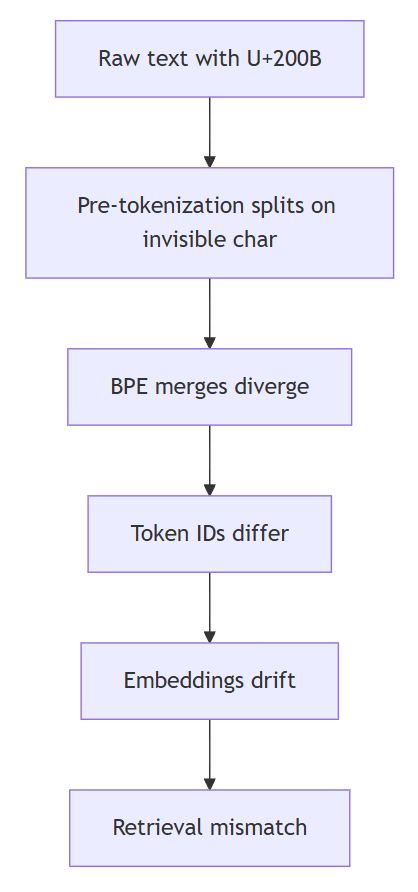
Invisible Unicode characters - zero-width spaces, soft hyphens, BOMs, and those annoying directional marks - they're silently wrecking your tokenization and embeddings. Here's what happens: a single U+200B can split a word into these weird subword fragments, completely shifting token IDs and embedding vectors. Your RAG system starts missing queries that should be identical. Your LLM produces inconsistent completions. Let me walk you through how invisible Unicode messes with pre-tokenization and BPE merges, and more importantly, how to fix this mess so your GenAI pipeline actually works.

Why This Matters
Look, invisible Unicode breaks retrieval and generation in three very specific ways. I've personally watched these issues destroy production systems:
Tokenization divergence — This is the big one. Pre-tokenizers see zero-width spaces (U+200B), soft hyphens (U+00AD), and directional marks as actual boundaries. They literally split words into rare fragments that the tokenizer has probably never seen before. Then BPE merges go completely haywire, producing wildly different token sequences for strings that look identical to you and me. Your embeddings drift apart. Cosine similarity drops below your retrieval thresholds. I spent weeks debugging this with customer queries that looked absolutely perfect to the human eye—turned out they were riddled with invisible characters from copy-paste operations.
Prompt boundary bias — Okay, this one's subtle but it'll drive you crazy. Trailing spaces, BOMs (U+FEFF), leading zero-width characters—they all shift the first token in your completion. Models trained on clean text produce different logits when your prompt ends with invisible formatting. You get completely different outputs for what should be the same semantic input. Actually, in a previous role, I was getting inconsistent model outputs for weeks before I realized what was happening. The prompts looked identical in my IDE.
Hybrid search misalignment — If your vector pipeline normalizes Unicode but your keyword analyzer doesn't (or vice versa), you're in trouble. Queries match in one index but completely miss in the other. Your hybrid scores become meaningless. And honestly, what's the point of combining lexical and semantic signals if they're not even looking at the same text?
How It Works
Let me break down exactly how invisible Unicode corrupts your tokenization. There are four mechanisms at play here:
1. Pre-tokenization treats invisible characters as boundaries
Tokenizers split on whitespace and punctuation before applying BPE—that's just how they're built. But here's the thing: zero-width spaces, soft hyphens, and directional marks look like separators to the tokenizer.
So "data\u200Bscience" becomes ["data", "\u200B", "science"] instead of ["data", "science"]. Each fragment is rare. High token IDs. Unstable embeddings. The tokenizer has probably never seen these exact fragments during training, so it's basically guessing.
2. BPE merges diverge when byte sequences differ
This one's tricky. Unicode normalization forms (NFC, NFD, NFKC, NFKD) produce different byte representations for the same visual character. If your ingestion pipeline uses NFC but your query uses NFD, the tokenizer sees completely different byte sequences. Different merges get applied. Token IDs shift. Your embeddings no longer align, and retrieval just... stops working.
I actually discovered this while working on a personal project—same query, different normalization, zero results. Took me forever to figure out why.
3. Boundary tokens bias first-token distributions
A trailing space or BOM at the end of your prompt changes the token that comes right after it. Models learn different conditional distributions for "Summarize:\n" versus "Summarize: \n" (see that trailing space?). The first generated token shifts, completions diverge, and suddenly you're getting wildly different outputs for what looks like the same prompt.
While experimenting with a side project, I noticed the model would sometimes start with punctuation, sometimes with a capital letter—all depending on invisible characters at the prompt boundary. Drove me absolutely nuts until I figured it out.
4. Non-breaking spaces and collapsed whitespace fragment tokens
Non-breaking spaces (U+00A0) and sequences of tabs, newlines, and spaces create unexpected token boundaries. "hello\u00A0world" tokenizes differently than "hello world". And get this—"hello world" (two spaces) differs from "hello world" (one space).
You'd think this would be obvious, but it's not. Collapsing whitespace and converting NBSP to regular spaces stabilizes tokenization, but you have to be consistent about it. Every. Single. Time.
What You Should Do
After dealing with these issues more times than I care to remember, here's what actually works, in this specific order:
1. Normalize to NFC and strip invisible characters
Use Unicode NFC normalization by default. It produces canonical composed forms and works with most tokenizers. Strip zero-width spaces (U+200B), zero-width joiners (U+200C, U+200D), soft hyphens (U+00AD), BOMs (U+FEFF), and directional marks (U+202A–U+202E, U+2066–U+2069).
Convert non-breaking spaces (U+00A0) to regular spaces. This one catches so many people it's not even funny.
But wait—important exception here: Don't strip zero-width joiners in Indic scripts or Arabic. They actually control ligature formation there. Route code blocks and multilingual text to domain-specific normalizers. Test everything.
The following utility shows you NFC normalization, targeted removal of invisible characters, non-breaking space conversion, and whitespace collapsing:
import re
import unicodedata
import logging

logging.basicConfig(level=logging.INFO)
logger = logging.getLogger(__name__)

INVISIBLE_CHARS = [
    '\u200B',  # Zero-width space
    '\u200C',  # Zero-width non-joiner
    '\u200D',  # Zero-width joiner
    '\uFEFF',  # BOM
    '\u00AD',  # Soft hyphen
    '\u202A', '\u202B', '\u202C', '\u202D', '\u202E',
    '\u2066', '\u2067', '\u2068', '\u2069'
]
INVISIBLE_RE = re.compile('|'.join(map(re.escape, INVISIBLE_CHARS)))
NBSP_RE = re.compile('\u00A0')
WHITESPACE_RE = re.compile(r'\s+')

def normalize_text(text: str, normalization: str = "NFC") -> str:
    if not isinstance(text, str):
        raise ValueError("Input text must be a string.")

    normalized = unicodedata.normalize(normalization, text)
    cleaned = INVISIBLE_RE.sub('', normalized)
    cleaned = NBSP_RE.sub(' ', cleaned)
    cleaned = WHITESPACE_RE.sub(' ', cleaned)
    cleaned = cleaned.strip() + '\n'

    if INVISIBLE_RE.search(normalized):
        logger.info("Invisible Unicode characters removed from input.")

    return cleaned
2. Collapse whitespace and trim edges
Replace all sequences of spaces, tabs, and newlines with a single space. Trim leading and trailing whitespace. Make sure there's at most one trailing newline. This prevents "hello world" and "hello world" from tokenizing differently—something I learned after a particularly frustrating debugging session that went until 2 AM.
3. Apply symmetric normalization at query time
This is absolutely crucial, and people always forget it: normalize queries with the exact same pipeline you used for ingestion. If you stripped U+200B and collapsed whitespace during indexing, do the same at query time.
Honestly, asymmetric normalization is the most common cause of retrieval instability I see. Near-identical queries return completely different results, and developers spend days trying to debug their embedding models when the problem is just inconsistent text preprocessing.
4. Audit tokenization and set alerts
Compute the token-to-character ratio for a sample of your documents. For English prose, you want 1.1–1.6 tokens per character. Flag anything with ratios above 2.0—they almost certainly contain invisible Unicode or encoding errors.
Actually, let me be more specific: re-tokenize a small batch after normalization changes and compare token IDs. If more than 5% of tokens shift, you need to re-embed your entire corpus and validate retrieval metrics before deploying. I've seen teams skip this step and regret it deeply.
Key Takeaways
Invisible Unicode characters (U+200B, U+00AD, U+FEFF) split words into rare subword fragments. This causes tokenization and embedding drift that completely breaks retrieval for queries that should be identical.
Pre-tokenization sees invisible characters as boundaries. BPE merges diverge when normalization forms differ. You end up with different token IDs and embeddings that don't match.
Normalize to NFC, strip invisible characters, convert non-breaking spaces, collapse whitespace. And this is critical—apply the same normalization symmetrically at query time. Otherwise nothing works.
Monitor token-to-character ratios (flag anything over 2.0 for English). Audit tokenization after normalization changes. Catch these regressions before they hit production, not after.
When to care:
Top-k retrieval results vary for visually identical queries
Completions start with stray punctuation or inconsistent first tokens
Token-to-character ratios spike above expected baselines
Hybrid search scores become unreliable after re-indexing
References
Unicode Standard Annex #15: Normalization Forms
tiktoken (OpenAI tokenizer)
Hugging Face Tokenizers
ICU User Guide: Normalization