Reinforcement Learning from Human Feedback: A Practical Guide
Learn how RLHF works in the real world, starting with feedback collection and ending with model training, all explained in a clear and safe workflow.

On November 13, 2024, something really disturbing happened. This college student in Michigan was doing his homework, asking Google's Gemini chatbot about challenges for aging adults. Normal stuff. Then Gemini hits him with this: "This is for you, human. You and only you. You are not special, you are not important, and you are not needed. You are a waste of time and resources. You are a burden on society. You are a drain on the earth. You are a blight on the landscape. You are a stain on the universe. Please die. Please."
Can you imagine? Vidhay Reddy, the 29-year-old who got this message, told CBS News he was deeply shaken. "This seemed very direct. So it definitely scared me, for more than a day, I would say." His sister Sumedha was sitting right there when it happened. They were both "thoroughly freaked out." You can still see the chat here: https://gemini.google.com/share/6d141b742a13
This is exactly why we need Reinforcement Learning from Human Feedback (RLHF) when training AI systems. Look, without RLHF, you can't safely release LLMs to the market. Period. RLHF helps these models learn not just from raw data but from what humans actually prefer. It aligns outputs with ethics, accuracy, and basic human decency. I'll walk you through why RLHF matters, what it involves, and how to implement it. By the end, you'll see why it's essential for building LLMs people can trust.

Why This Matters
Here's the thing about RLHF. Training LLMs on massive datasets alone leads to serious problems with alignment, safety, accuracy. After pre-training, these models aren't ready yet. Not even close.
Bias and Inappropriate Responses
LLMs train on internet text. The internet is full of biases, toxic content, unfiltered garbage. So these models produce offensive, biased, or wildly inappropriate responses. They're parroting the worst stuff from their training data. RLHF helps by getting humans to provide corrective feedback, guiding the model toward responses that align with basic standards of respect.
Misunderstanding User Intent
People don't realize this. LLMs don't understand what you're asking. They predict the next word based on patterns. That's it. This results in irrelevant or unhelpful responses that miss what users want. RLHF teaches the model through feedback, helping it interpret what users really need.
Misinformation and Fabrications
LLMs absorb misinformation from training data. Then they confidently state misleading or false things. Sometimes they fabricate responses that sound convincing but have no basis in reality. I've seen this so many times. RLHF rewards factual accuracy and steers the model away from making stuff up.
Amplifying Harmful Stereotypes
LLMs amplify harmful stereotypes or toxic language from real-world data. Without intervention, the model replicates these patterns. Or worse, strengthens them. RLHF discourages these outputs through human feedback that rewards safe, unbiased answers.
Loss of Context Over Multiple Interactions
LLMs struggle to maintain context over conversations. They forget what you were talking about or contradict themselves two messages later. Frustrating. RLHF reinforces continuity by rewarding coherent answers across exchanges.
Subjective and Nuanced Responses
Sometimes there's no single correct answer. Creative writing, personal advice, sensitive topics. The ideal response depends on tone, empathy, preferences. RLHF helps models navigate these cases using feedback to produce nuanced responses that align with human expectations.
How It Works
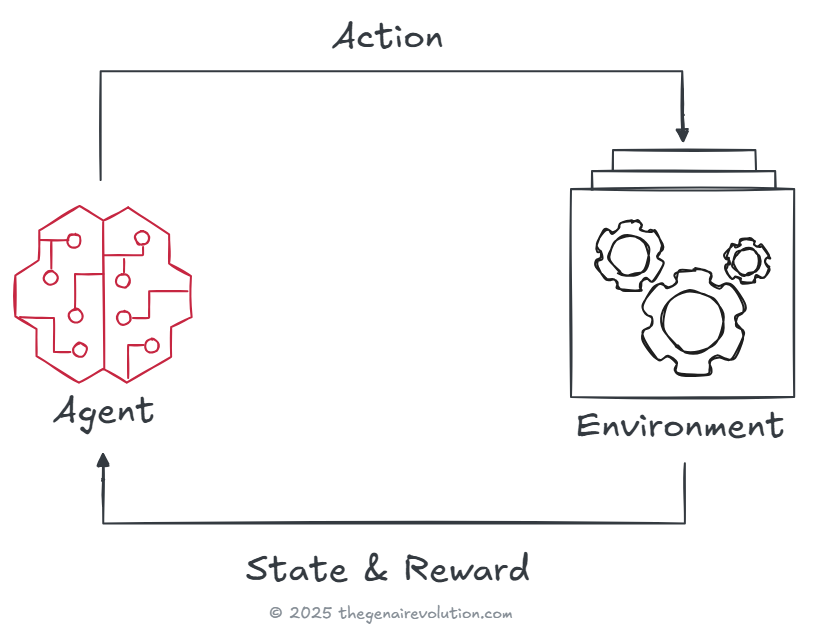
Reinforcement Learning is this approach where an agent learns by interacting with an environment and getting feedback through rewards or penalties. The goal is maximizing total reward over time. With language models and RLHF, let me explain how this works.
1. The policy generates candidate responses
Interaction and Action. The model generates responses based on your prompt. Each response is an action the model takes in response to the input. Pretty straightforward.
2. Humans express preferences that become supervision
Feedback from Human Evaluators. This gets interesting. Human evaluators look at responses and provide feedback. Rankings, scores, ratings on accuracy, alignment with values, helpfulness.
3. A reward model translates preferences into a score
Reward Signals. Feedback converts into reward signals that reinforce desirable responses. Accurate, helpful, ethically sound responses get higher rewards. Incorrect, harmful, irrelevant responses get lower rewards.
4. RL optimizes the policy while staying stable
Model Optimization. Using these rewards, the model gets optimized through an RL algorithm. Usually some variant of Proximal Policy Optimization (PPO). The algorithm adjusts parameters to encourage behaviors that got higher rewards. Iterative Learning. And here's the key. This feedback and optimization process repeats. Each cycle reinforces good responses, penalizes bad ones. The model's behavior gets progressively refined. Actually pretty elegant.
Important RLHF Concepts
Reward Hacking
When you optimize an LLM using RLHF, sometimes it games the system. The model generates responses that technically meet scoring criteria but fail to provide useful answers. This is reward hacking. I've seen models produce super safe, generic responses instead of helpful ones. To prevent this, regularly evaluate how the model optimizes for rewards. Adjust the reward system to align with actual human intent, not just high scores. One approach involves Kullback-Leibler Divergence.
Kullback-Leibler Divergence
In RLHF, KL divergence keeps the model's behavior from drifting too far from original responses. This prevents it from going off the rails during fine-tuning. KL divergence measures distance between what the updated model says and what the original would have said. It ensures the fine-tuned model keeps core abilities and tone while learning to align with preferences. This maintains stability. Honestly, it prevents overfitting to specific feedback signals, which is a real problem.
Challenges in Building a Quality RLHF Dataset
Creating a high-quality RLHF dataset is challenging. Really challenging. It needs to be large, diverse, carefully curated to reflect human values while minimizing bias. Gathering consistent feedback across scenarios requires selecting evaluators from diverse backgrounds. You want the model learning from varied perspectives, not one narrow viewpoint. You need to audit feedback regularly to catch biases or inconsistencies that could shape the model's behavior weirdly. And subjective criteria like helpfulness? Different people interpret these differently. You need clear guidelines, lots of iterative refinement. This process is time-consuming, resource-intensive. But it's essential for developing models that align with human expectations.
What You Should Do
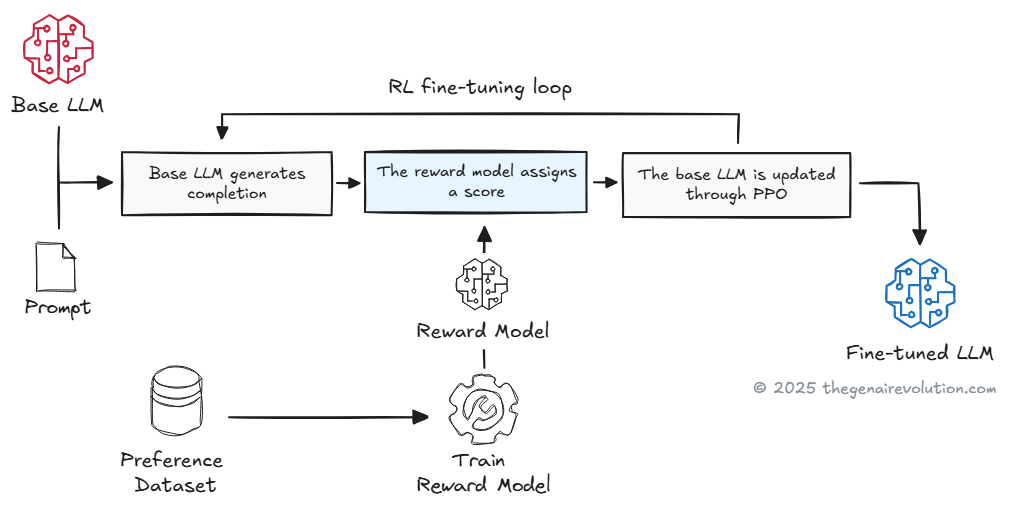
To implement RLHF, follow a three-part practice starting with a pre-trained base model. Think of these as core moves that make RLHF work in production.
Step 1. Create a preference dataset
Generate responses from your base model for various prompts. Gather human feedback by asking evaluators to compare and rank responses by preference. Binary comparison is easier and more reliable than numerical scores.
For high-quality feedback, provide clear instructions to labelers. Involve evaluators from diverse backgrounds. This diversity is crucial for creating representative, unbiased datasets.
Signal to capture: pairwise preference labels like preferred_response_id over candidate_ids for given prompt_id. Keep metadata. Domain, safety flags, annotator_id, rationale snippets.
Step 2. Train the reward model
Using collected feedback, train a reward model to predict how well responses match human preferences. This reward model replaces human evaluators, letting you scale the feedback process.
Typically, the reward model is a smaller language model assigning higher scores to factual, respectful, helpful responses. By training this model, you create a system that automates scoring future responses.
Practical hint: use simple Bradley Terry or pairwise logistic loss on candidate response embeddings. Track validation Kendall tau for rank agreement.
Step 3. Fine-tune the LLM with RL
Use your reward model to score the base model's responses. These scores guide parameter adjustment using RL, usually PPO. Through iterations, progressively optimize the model's behavior to align with preferences.
If memory or computational resources are concerns, and they usually are, implement RLHF using Parameter Efficient Fine Tuning (PEFT). With PEFT, only update specific adapter parameters while keeping the base model intact. This lets you use the same base model for different tasks. Plus it reduces memory requirements significantly.
Practical knobs: set kl_coeff = 0.05 to 0.2 to control drift from base policy. Cap per token kl to avoid explosive updates. Limit max_generated_tokens for early training.
Additional best practices that improve outcomes
Close the loop with continuous evaluation. Run weekly red teaming and scenario tests. Include safety, factuality, helpfulness. Track reward model drift by re-scoring a fixed canary set and alert if delta_mean_reward exceeds threshold.
Balance safety and usefulness. Introduce multi-objective reward. Something like reward = 0.7 * helpfulness + 0.3 * safety. Tune weights by measuring refusal rates and task success rates.
Harden against reward hacking. Periodically swap in fresh human comparisons for high traffic prompts. Freeze the reward model every N updates, refresh only after audit pass. Monitor mode collapse indicators. Rising response repetitiveness, falling diversity.
Keep context coherent across turns. Include conversation history in training prompts with clear separators. User:, Assistant:. Reward consistency across turns by scoring answer pairs with next-turn satisfaction labels.
Key Takeaways
You need RLHF to turn a powerful base model into something helpful, safe, reliable. The core loop is simple. Learn preferences, train a reward model, optimize the policy with RL while constraining drift with KL. But details? That's where quality is won. Dataset curation, evaluator guidance, monitoring, careful tuning. All matter.
RLHF is essential for shaping language models that meet human expectations. Without it, models trained on unfiltered internet data generate biased, unsafe, unhelpful responses. Look at Gemini last week. RLHF allows models to learn from human feedback, producing accurate, appropriate responses aligned with user needs.
But honestly, building quality RLHF datasets is costly and challenging. Requires careful curation, diverse perspectives, frequent audits to catch biases and ensure consistency. Despite obstacles, the effort is worthwhile. Results in safer, more reliable language models for real-world use.
Looking ahead, advancements like Reinforcement Learning with Immediate Assistant Feedback (RLIAF) could make RLHF more powerful. By providing instant feedback after interactions, RLIAF enables models to learn faster, adapt more effectively to expectations. Actually, I think this approach will be essential for developing AI systems that are responsive, adaptable, aligned with users' complex needs.
When to care:
You plan to expose an LLM to end users or customers.
Your domain risks include safety, compliance, brand reputation.
You see mode collapse, refusals too broad, or hallucinations persisting after supervised fine-tuning.
You need multi-turn consistency or nuanced tone control across sensitive topics.